
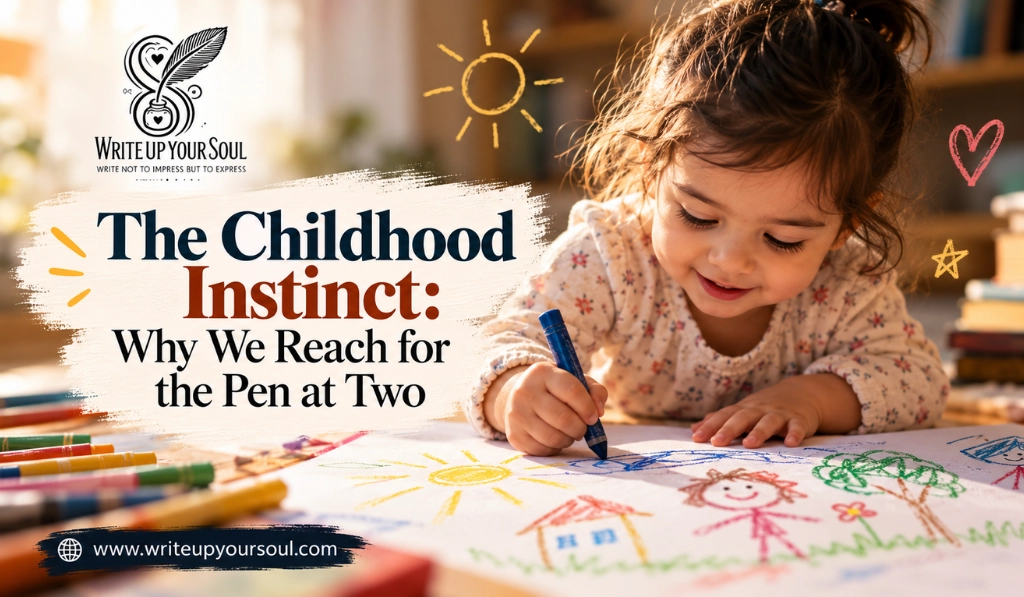
Quick Answer: A two-year-old scribbles without a plan, a goal or a filter, which is the purest form of self expression. As we grow up, we learn to edit our feelings before they reach the page. To write honestly again, you only need to drop the filter and let the first true sentence stand.
Put a wax crayon in the hand of a two-year-old child, and something quiet yet extraordinary happens.
They don’t pause to ask what they are supposed to draw. In fact, if you ask them what they are making, they don’t even know themselves. They aren’t trying to paint a landscape, draw a house, or capture anything recognizable. They have no plan, no strategy, and no filter.
They simply do it from the soul. They express whatever raw, unspoken feeling is swirling inside them in that exact second.
With pure, unthinking instinct, they press the tip down onto whatever surface sits in front of them—a sheet of paper, a wooden table, or a bare living room wall—and drag it across with absolute conviction. That bold, erratic scribble is rarely about art. It is a human being’s very first realization that they carry an inner world, and that their inner world can leave a physical mark on the vast outer world.
Why Do We Reach for the Pen at Two?
At two years old, we reach for the pen simply because we are completely free from filters. Nobody has stepped in yet to tell us what is right or wrong, neat or messy, beautiful or foolish. We haven’t been taught to second-guess our marks, hide our messiness, or ask for approval before we express who we are.
Long before we ever learned how to form full words, spell our names, or speak in structured sentences, we already felt that simple, urgent need to show up and declare, “I am here.”
If you watch a toddler make those first marks, you notice a complete absence of hesitation. There is no inner critic hovering over their shoulder, no draft folder full of unfinished thoughts, and no lingering worry about what an audience might think. The scribble is pure, unfiltered human spirit.
When Do the Filters Get Turned On?
Then, quietly, as we grow up, the filters get turned on.
We are handed coloring books and subtly coaxed to stay inside pre-drawn lines. We learn to pay more attention to what is expected of us than to what we actually feel inside. Slowly, almost imperceptibly, we start editing our thoughts before they even reach our minds, terrified of making a mistake, looking messy, or standing out.
We become so accustomed to filtering our instincts that we forget how to feel without judging ourselves first.
Why Does a Blank Page Feel So Heavy as an Adult?
This is why, when an adult sits down in front of a blank notebook or a clean digital document today, the room suddenly feels so heavy.
The hand lingers above the page. We write a sentence, feel a subtle wave of hesitation, and immediately erase it. We replace our genuine, unfiltered thoughts with safer, more polished phrases. We spend twenty minutes smoothing over the rough edges until our words sound composed, respectable, and completely harmless.
We think we are just trying to write well, but in reality, we are suffocating under the weight of our own filters.
How Do You Reconnect With Your True Voice?
We forget that the original urge to write had nothing to do with perfection, performance, or external praise. It was never an intellectual audition. It was simply the act of giving your inner life a physical home—a quiet sanctuary where you do not have to defend your feelings, justify your thoughts, or prove your worth.
Connecting back to your true voice isn’t about learning a brand-new talent. It is about dropping the filter. It is about having the courage to remember who you were before you learned to second-guess your own voice.
The page in front of you today holds no judgment. It does not care about rules, rubrics, or technical perfection. It is simply waiting for you to pick up the pen, write without a filter, and feel what you actually feel—just as you did when you were two years old.
Frequently Asked Questions
Why do toddlers scribble?
Scribbling is a toddler’s first way of turning an inner feeling into a mark. Children typically begin making simple scribbles around their first birthday, and by about two the marks become more controlled, as this overview of children’s art explains. The scribble is rarely about drawing anything recognizable.
Why do we stop expressing ourselves freely as we grow up?
Because we slowly learn to watch what is expected of us more than what we feel. Coloring books, rules and the fear of looking messy teach us to edit our thoughts before they are even formed, so the filter turns on without us noticing.
How do you write without a filter?
Start with one honest sentence and let it stand without erasing it. Keep your pen moving, skip the urge to polish, and treat the page as private. The ten-minute FGF Formula for writing for self expression (Feel, Filter, Flow, Free) gives you a simple way to begin.
Why does a blank page feel so heavy for adults?
Because we write a sentence, hesitate, and erase it in favour of something safer and more polished. The page itself holds no judgment. The heaviness comes from the filters we carry into the room.
How can parents encourage a child’s self-expression?
Let the child explore without correcting the result. The CDC’s milestones page for 2-year-olds suggests giving a toddler crayons or finger paint and letting them explore by spreading it around and making dots.
Keep Writing With Write Up Your Soul
If this made you want to pick up the pen again, read The First Mark: Why We Write next, or start with our guide to writing for self discovery. Write Up Your Soul is led by author and speaker Dr. Sarita S Chauhan, and you can reach out through the contact page to share your own writing journey.