
Quick Answer: Why we write comes down to one need: to turn invisible feelings into something real. The first mark on a cave wall was humanity’s earliest way of saying “I am here,” and unfiltered writing today is the same instinct. It lets you stop performing, say what is true, and leave proof that your inner life exists.
We edit ourselves into ghost stories.
We swallow our rawest thoughts, smooth over our rough edges, and quiet our genuine voices just to feel safe from judgment. We go through life performing, reacting, and editing away the very things that make us human.
What Was the First Mark?
But before there were countries, structured languages, or formal classrooms, there was silence. And inside that vast, ancient silence, humanity faced its deepest fear: the terrifying reality that a life could pass by, fade into dust, and leave no trace behind.
We were never content to simply disappear.
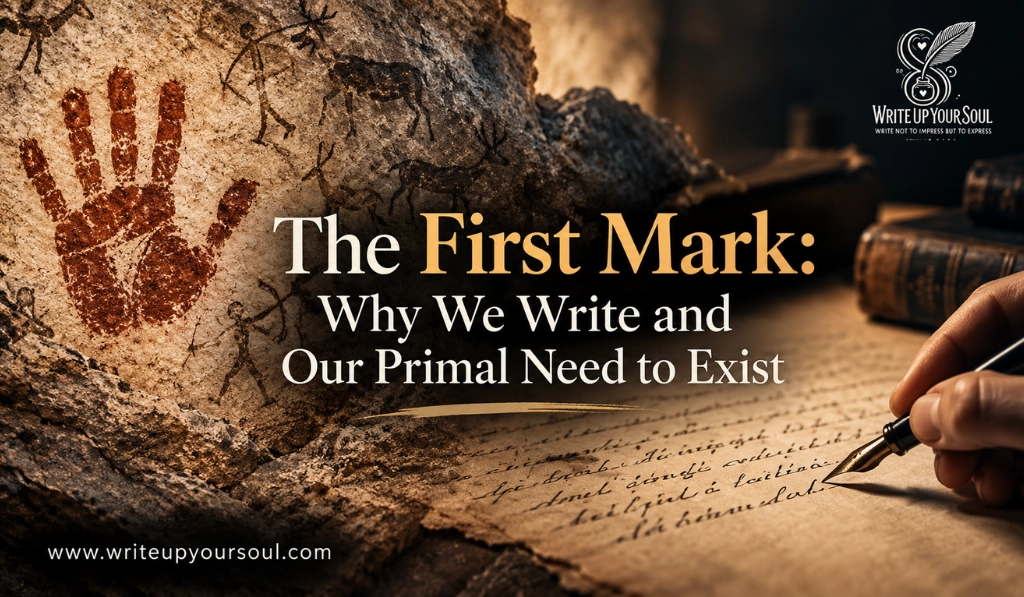
Driven by a raw, unspoken impulse, an early human reached out, dipped a hand into pigment, and made a single line across a bare cave wall.
That single line was the first mark.
It was not created for an assignment, nor was it meant for an audience or a grade. It was a visceral, desperate declaration of being. It was humanity’s very first primal act of survival—a way to carve our temporary spirit into permanent stone and whisper to eternity: “I am here. I exist.”
Understanding the first mark is not about studying history or mastering writing techniques. It is about recognizing the primal urge that still lives inside you today—the need to stop performing, set your spirit free, and leave undeniable proof of your existence.
Why Did Early Humans Make Marks That Could Not Feed Them?
Imagine the world tens of thousands of years ago. Early humans were in a relentless struggle against hunger, harsh weather, and constant danger. By all logical standards, spending precious energy carving rock offered no physical nourishment.
Yet, they did it anyway. They did it because human beings do not merely exist to survive physically; we exist to feel, to process, and to declare our presence.
The terror of non-existence—the quiet fear of being completely forgotten—is coded deep into our DNA. The creation of the first mark was humanity’s original revolt against mortality. It was our way of proving that while our bodies are fragile, our thoughts and emotions carry weight that deserves to endure.
Why Do We Still Write Today?
When you sit down to write today, you are connecting directly with that ancient survival strategy. Writing is your personal answer to the silence of the world—the vessel through which you ensure your inner life is not erased by time.
When that early human pressed an ash-covered hand against a dark stone wall, self-awareness took a physical form. For the first time in history, an internal feeling was converted into an external, tangible object. The creator could step back, look at the wall, and see proof of their own mind staring right back at them.
That first mark wasn’t constrained by style guides, grammar rules, or technical anxiety. It required only one element: pure, unvarnished honesty.
In our modern lives, we have buried this primal instinct beneath layers of overthinking. We worry about proper structure, refined vocabulary, and external opinions. But the underlying pulse remains unchanged. Deep down, every word we write is still just an extension of that ancient handprint on stone—a simple statement saying, “This is who I am, and this is what I feel.”
How Does Unfiltered Writing Cure Performance Fatigue?
Making an authentic mark is the ultimate cure for performance fatigue. When you write without filtering or self-censorship, you step out of the role you play for others and step directly into raw existence. You stop trying to please an external standard and start giving form to your genuine soul.
Unfiltered writing demands that you strip away the masks. It creates a private sanctuary where you don’t have to be smart, clever, or perfect—you simply have to be present.
How Does Writing Make Invisible Emotions Visible?
Human emotions are invisible. Grief, joy, confusion, and love exist within us as swirling, intangible waves of energy. When we bottle them up, they create mental clutter and deep emotional fatigue.
Writing is the sacred process of making the invisible visible. It acts as a mirror that reflects the true state of your soul.
Unspoken anxieties lose their terrifying power the moment they are named on a page. Transferring a thought from your mind onto a physical surface lightens the weight you carry inside. When you allow your words to move without judgment, your truest feelings surface, offering unexpected self-discovery.
By making a mark, you take the chaotic inner world of your spirit and anchor it into reality.
Why Does Your Voice Still Matter?
It is easy to look around at a crowded world and ask yourself whether your voice really matters, or if everything has already been said before. But you do not make your mark because the world needs another polished masterpiece. You make your mark because it is your primal need to exist.
No other human in history has ever carried your exact mix of memories, heartbreaks, victories, and perceptions. No one else sees the world through your specific eyes. If you withhold your mark, a unique piece of the human story remains forever lost in the dark.
Your mark is not about achieving fame, recognition, or academic perfection. It is about fulfilling humanity’s oldest duty: honoring your time on this earth, claiming your identity, and leaving proof that your spirit was alive and free.
Writing was never meant to be a technical chore, an academic test, or a performative routine. It is your birthright—a sacred, primal instinct designed to anchor your existence and liberate your soul.
Make Your Mark Today
The next time you feel hesitation, technical anxiety, or self-doubt, pause and remember where it all began. Remember the dark cave, the cold wall, and the courageous hand that reached out to leave the very first mark.
Forget the rules. Forget the judgment. Reclaim your voice.
Make your mark, affirm your existence, and set your spirit free.
Frequently Asked Questions
Why do we write?
We write to turn invisible thoughts and emotions into something we can see, hold and understand. Writing lets us name what we feel, remember who we are, and leave proof of our existence, which is the same urge behind the first marks humans made on cave walls.
What was the first mark in human history?
No one can point to a single first mark, but early humans left marks such as hand stencils and simple shapes on cave walls tens of thousands of years ago. This overview of cave painting explains how these marks are found and dated.
What is unfiltered writing?
Unfiltered writing is writing without editing yourself as you go. You do not worry about grammar, vocabulary or what anyone will think, and you simply put honest thoughts on the page. It is the opposite of performing for an audience.
What does writing without self-censorship look like?
It looks like writing the true sentence first and judging it later, if at all. You keep your pen moving, let rough or uncomfortable thoughts stay on the page, and treat the first draft as private.
Is writing good for mental health?
Some research suggests expressive writing can bring short-term relief for some people, but results are mixed and writing is not a replacement for professional support. For example, a randomized study of first-year college students found lower depression symptoms two months after an expressive writing exercise, though the effect did not last at later check-ins. If you are struggling, please reach out to a mental health professional.
Do I need to be a good writer to start?
No. Grammar, spelling and style do not matter in this kind of writing, honesty does. You can begin with writing for self discovery and the ten-minute FGF Formula: Feel, Filter, Flow, Free.
Keep Writing With Write Up Your Soul
Ready to put your own first mark on the page? Start with our guide to writing for self expression, built on the simple idea of writing not to impress but to express. Write Up Your Soul is led by author and speaker Dr. Sarita S Chauhan, who gave the TEDxNerul talk of the same name. If you would like to talk about your own writing journey, you can reach out through the contact page.